From online shops that hurt the brand to a European B2B and B2C sales system
A manufacturer of professional motorcycle and bicycle care products, and official technical partner of MXGP, was selling online through shops that hurt the brand. Today it has online shops and B2B portals in several markets, built and developed by one person.
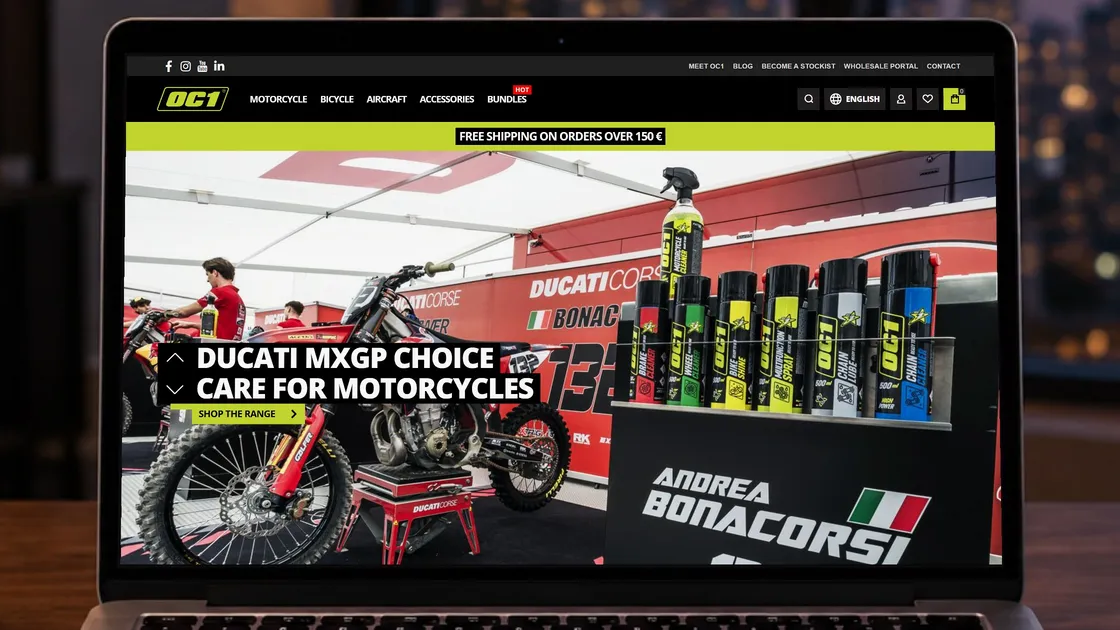
- Client
- OC1 Official
- Industry
- Motorcycle and bicycle care products
- Platform
- Magento 2
- Scope
- Implementation, Integrations, Development, Analytics, Technical support
- Role
- Business analyst, product owner, developer
- Duration
- Since September 2025, selling since January 2026
- Way of working
- One person, working with AI from day one
- Website
- oc1official.com
Starting point
OC1 makes professional motorcycle and bicycle care products, manufactured in Germany. The brand is an official technical partner of MXGP and title sponsor of the Polish Motocross Championship.
The company grew on B2B sales, through distributors and partners in more than a dozen countries. Online, the brand came across poorly:
- two old shops, one for Poland and one for Europe, full of errors;
- no mobile version;
- the shops did not reflect the standing of a brand trusted by MXGP factory teams;
- ads sent traffic to shops that were unable to sell.
On top of that came two legal entities and two currencies, distributors the manufacturer's shop must not undercut on price, legal requirements for chemical products and a deadline: launch before the motocross season.
Goals
- An online presence consistent with the brand that supports the trust of B2B partners.
- A B2B portal that makes wholesale ordering easier.
- Direct sales without conflict with distributors.
- A foundation for further markets.
My role
I have been responsible for the project from the first conversation to this day:
- business analysis: workshops, gathering requirements, a roll-out plan in stages;
- product owner: scope, priorities and responsibility for the result;
- organising the work: schedule, tasks and documentation;
- developer: building and rolling out the shops myself, supported by AI tools.
What I did
- New shops on Magento. The main shop serves Poland, Europe and Germany, and each market also has a B2B portal. The first versions went live four months after work began, before the season.
- Mobile first. Shops fully adapted to phones, because that is where most traffic comes from.
- Content rewritten. The whole catalogue rewritten to one standard, in five languages, with care for compliance with the rules for chemical products.
- An offer instead of a price war. Bundles and products available only from the brand.
- Custom extensions where ready-made Magento solutions did not exist or were of poor quality: B2B sales, legally compliant pricing, payment and shipping rules, sync with marketplaces, sales tracking.
- Integrations with external systems: payments, logistics, marketplaces (Allegro, Empik), Google and Meta.
- SEO, performance and visibility in AI. Technical optimisation, tidy language versions and readiness for AI assistants.
- Advanced analytics. Sales tracking that respects user consent and that campaign decisions can rely on.
- New markets. Shops for the Netherlands and Sweden as separate installations.
Working with AI from day one
AI tools are a constant part of my work: in analysis, content and translation, code and the day-to-day running of the shops. Decisions and responsibility stay with me. AI lets one person do and check much more. Changes to the live shops follow fixed rules: preview, backup and a check after release.
More about how I work with AI.
A project that does not depend on one person
I still develop and maintain the OC1 shops day to day. From the start I have also made sure the project can be handed over without downtime:
- code with its full history in a repository;
- documentation and tasks in ClickUp;
- well-organised access;
- hosting with a company that builds Magento shops itself.
Result
- Brand goal achieved. The brand has online shops that match its standing in the sport.
- B2B is moving to the portal. Most new partners order through the platform from the start, and existing ones are joining too.
- The B2C shop sells. Campaigns that used to send traffic to broken shops now convert.
- From the start of work to the launch of the shops and B2B portals
- 4 months
- Polish, English, German, Dutch and Swedish; the English version serves all of Europe
- 5 languages
- Custom Magento extensions
- About 30
- Integrations with external systems
- Over 20
What I learned
What surprised me
- Ready-made does not mean good enough. I assumed I would buy most features as off-the-shelf extensions. In key areas such as B2B, payments and marketplaces, I had to build my own.
- Regulations reach further than the label. In the chemical sector they also cover descriptions, prices and environmental claims, separately in each language.
Skills I had to expand
- Tracking: server-side analytics and working with user consent.
- E-commerce law: chemical products and consumer protection.
- Working with AI: I built my own way of working, meaning rules, documentation and clear limits on what AI may do. Security and personal data protection were central to it: AI has no access to passwords or customer data.
Takeaways
- A manufacturer's shop wins on its offer, not on price.
- Tracking is part of the roll-out, not an add-on.
- A good shop also works for B2B. It convinces a wholesale partner just as it does a retail customer.
Key skills
- Business analysis
- Product management
- E-commerce strategy
- Magento 2
- B2B sales
- System integrations
- SEO
- Visibility in AI search
- Web analytics
- Expert content
- Translations
- Working with AI
Got a project to discuss?
Tell me what you want to achieve. I will tell you what I can do myself and where it is worth bringing in specialists.