From a need in my own conversations to an app that gives live hints
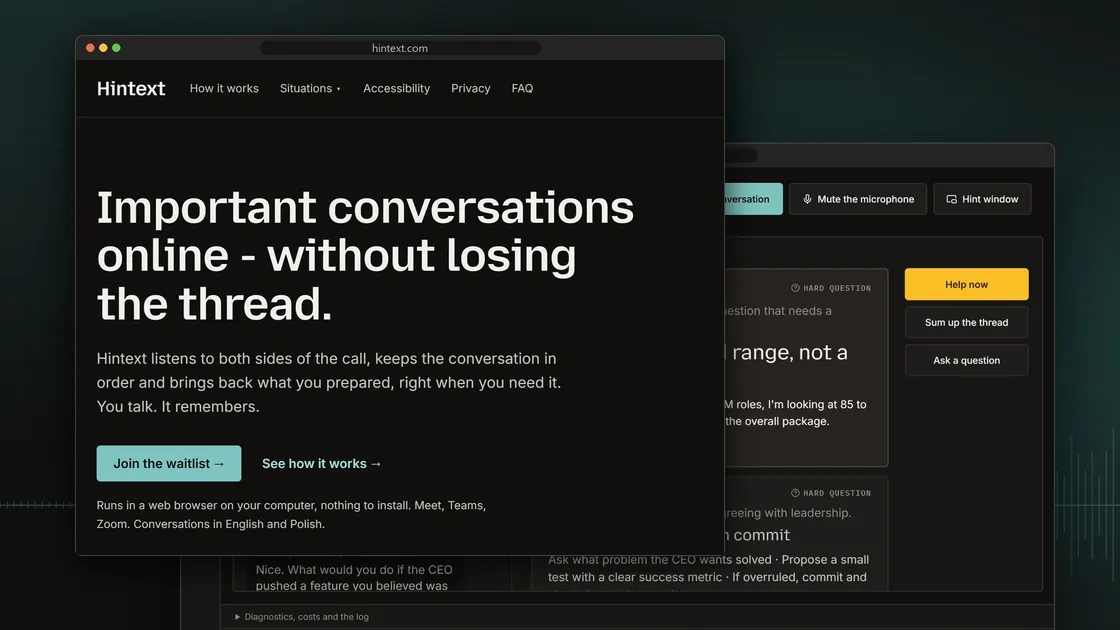
Hintext is my app that transcribes both sides of an online conversation live, suggests short hints as you talk and prepares a note afterwards. I came up with it for myself, built it on my own with the help of AI and took it to an online version with user accounts.
- Client
- My own product
- Industry
- Online conversation assistant
- Platform
- Browser-based app with AI
- Scope
- Implementation, Development, Analytics
- Role
- Originator, product owner and builder
- Duration
- Since July 2026
- Way of working
- One person with an AI coding assistant
- Website
- hintext.com
Starting point
As a business analyst, I have a lot of online conversations: I gather requirements, ask follow-up questions and agree on details. In a conversation like that, I need to focus on the other person. I cannot take notes or search the project documents at the same time, because I lose the thread.
I needed a tool that would suggest what to ask during the conversation, remind me of the wider project context and prepare a note afterwards. I had one criterion: a hint has to come at the right moment and fit the conversation, the question and the situation.
I set three assumptions:
- it works in the browser, with nothing to install;
- I build it myself, with the help of AI, on a low budget;
- every conversation includes another person who has not agreed to anything, so data protection has to be built into the product itself, not added at the end.
Goals
- Take the load off attention and memory during the conversation. A hint appears when it is needed.
- A note without note-taking. It is created after the conversation, from the full transcript.
- The tool suggests, the person decides. A hint is something to choose from, and a note is a draft to edit.
- The other person's data protected from the start. No recordings, and both the server and speech-to-text are in the European Union.
My role
Hintext is my own product. I have run it myself, from the idea to today:
- idea and direction: what problem I solve, for whom and what I deliberately do not build;
- product owner: scope, order of work and decisions, including ones that go against AI suggestions;
- building with AI: AI writes the code, I describe what needs to be built, test it live and sign off each stage;
- testing in real conversations: after each use I draw conclusions and make one change at a time;
- data protection: processing rules, legal documents and choice of providers.
What I did
- Hints during the conversation. Hintext transcribes what both sides say live and suggests short hints: how to answer, what to ask, what a term that has just come up means.
- Two separate audio channels. My microphone and the other person's voice are kept apart, so the app knows who is speaking without guessing.
- Conversation profiles. Before a conversation, I describe who I am, what the conversation will be about and what I expect from the hints. I can attach project documents. I can also dictate a profile and AI will put it together for me.
- Custom buttons. “Help now” and commands you set up yourself, such as “Summarise the thread”.
- Note and history. After the conversation, a note is created from the full transcript. The conversation history is stored in the account or only in the user's browser.
- Online version with accounts. Log-in, invitation-only sign-up, usage limits and an admin panel.
- Transparent costs. A live counter and a report after each conversation.
- Two languages and accessibility. Interface in Polish and English, with settings for text size, contrast and motion.
- Legal documents. Terms of service, privacy policy and cookie policy, in Polish and English.
From a program on my computer to an online product
The first version took a few days to build and ran only on my computer. I used it in real conversations and after each one wrote down what got in the way. That led to the next changes: hints stopped repeating and now appear at a better moment, and I added a note after the conversation and a profile wizard. I soon decided that other people should be able to use the tool too. That is how the online version came about: accounts, limits, conversation history and data deletion. Then came a two-language interface, legal documents and a review of the whole product.
Building with AI
AI writes all the code, while I decide what needs to be built, check each stage live and sign off the result. To make this work over months, I needed rules: a project memory with decisions and the reasons for them, automated checks that stop a bug before it goes live, and measurement instead of guesswork. I turned every bug that came back into a check. Finally, I reviewed the whole product and made fixes.
The other person's data
Every conversation includes someone who has not signed up to Hintext. That is why the app does not record conversations and the audio does not pass through its server. The server and speech-to-text run in the European Union. Users choose whether their conversation history is stored in their account or only in their browser, and they can choose a European AI provider. There are also lines the product does not cross: it does not detect emotions and does not judge people.
Result
- Hintext is online. I use it in my work as an analyst, for analysis and gathering requirements.
- Hints come at the right moment and fit the conversation.
- The product is still being developed.
What I learned
What surprised me
- A rule written in words is not enough. AI forgets it just as a person does. What works is an automated check that stops the error.
- The biggest savings come from what AI does not have to do. Costs fell the most when part of what was said stopped being sent for analysis at all.
- Switching AI providers takes days of fine-tuning, not the flick of a switch.
Skills I had to expand
- Working with code and deployments: repository, automated tests, my own server.
- Data protection: GDPR, AI regulations and where data is processed.
- AI in the product: several models in one app, each with its own time and cost budget.
Takeaways
- Start with your own, specific problem. Then you know straight away whether the solution works.
- Test in real situations and change one thing at a time.
- Build data protection into the design itself. Data you do not collect, you do not have to protect.
- AI writes the code, but decisions and checks stay with a person.
Key skills
- Business analysis
- Product management
- Product thinking
- AI in the product
Got a project to discuss?
Tell me what you want to achieve. I will tell you what I can do myself and where it is worth bringing in specialists.