From my own idea to a rehabilitation equipment shop I ran for 14 years
Actimed was my own company and my first big project. The idea grew into one of the first online shops for rehabilitation equipment in Poland, which I ran for 14 years.
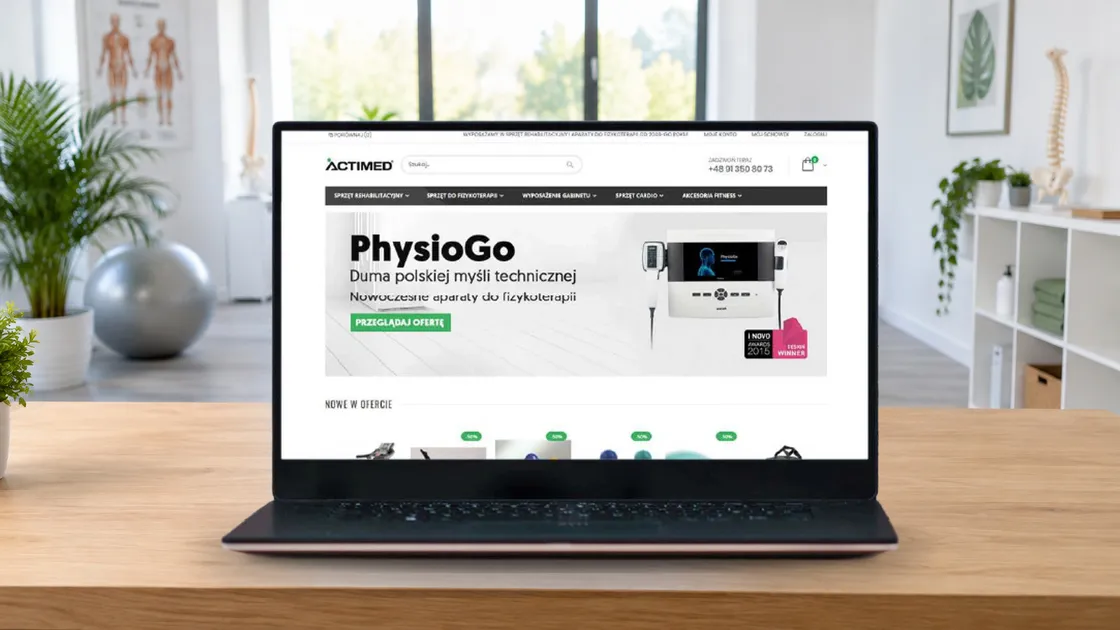
- Client
- Actimed (my own company)
- Industry
- Rehabilitation and medical equipment
- Platform
- Easy Shop, Shoper, WooCommerce, PrestaShop, Magento 1 and 2
- Scope
- Implementation, Development, Analytics
- Role
- Founder and owner
- Duration
- 2003–2017
- Way of working
- My own company, a team of up to 5 people
Starting point
Before I founded Actimed, I worked in a shop selling rehabilitation and medical equipment. I knew the industry and had trade contacts. I had also been building websites for a long time. I decided to combine the two and build my own online shop.
At the time, there were almost no online shops in this industry. Companies had websites where you could not buy anything, or poor-quality shops.
There was also a limit on the supplier side. Manufacturers and wholesalers shipped goods to the retailer, not straight to the retailer's customer. To sell a wide range, I had to change that.
Goals
- Sell rehabilitation equipment online to individuals and businesses across Poland.
- Stand out on quality: a clear shop and a simple path to purchase.
- Offer a wide range without keeping all the stock in my own warehouse.
- Have full control over the shop and develop it myself.
My role
I was the founder and owner. I was responsible for the whole company:
- idea and business model: industry, customers, how to sell;
- product range: choosing products, import and distribution;
- shop: choosing the platform, rolling it out and developing it, each time by myself;
- sales and customer service: from the order to after-sales support;
- analytics: data on the shop and sales;
- team: I led a team of up to 5 people.
What I did
- One of the first online shops in the rehabilitation industry in Poland. I focused on quality and a simple path to purchase.
- Roll-outs on one platform after another. Easy Shop, Shoper, WooCommerce, PrestaShop, Magento 1 and finally Magento 2. I rolled out and developed each one myself.
- Shipping straight from supplier to customer. Suppliers and manufacturers sent orders directly to my customers.
- A range of almost 1000 products, including goods I imported myself.
- Sales to individuals and businesses, roughly half and half. Hospitals and care centres placed many orders. They bought in the shop like any other customer, without tenders and without a separate panel. They valued being able to order many complementary products easily in one place.
- The whole order journey: purchase in the shop, packing in the warehouse, delivery and after-sales support.
- Analytics for the shop and sales.
Shipping straight from supplier to customer
At the time, nobody in my industry worked this way. Suppliers and manufacturers sent goods to the retailer, who only then sent them on to the customer. I had to persuade them to ship orders straight to my customers. This was new to them, so it took many conversations and a lot of trust. Suppliers had no way of connecting their systems to the shop, so I passed orders on by email, by phone and often by fax. This let the shop offer a wide range without keeping everything in stock. Today this model is common. In the rehabilitation industry, I was one of the first to introduce it.
A platform matched to the company's needs
Over 14 years I changed the shop platform several times: from Easy Shop, through Shoper, WooCommerce and PrestaShop, to Magento 1 and Magento 2. I rolled out and developed each one myself and paid only for the licence. I did not choose subscription-based shops, because I wanted access to the server and full control over development. When Shoper moved to a subscription model, I dropped it. I changed platforms when one stopped meeting the company's needs. Magento worked best. Building shops is my passion, and each move taught me something new.
I know what it is like on the owner's side
Running Actimed, I went through the whole customer journey: from winning the customer, through the purchase in the shop and packing the parcel in the warehouse, to delivery and after-sales support. I paid for every decision myself. That is why today, when I work for clients, I look at a shop through the owner's eyes, not just a contractor's. I know that a shop is not just a website, but also suppliers, a warehouse, customer service and money.
Result
- The idea became a company, which sold online for 14 years to individuals, businesses and the public sector.
- The shop paid its way in its final years too.
- Experience I now use with clients. In 2017 I closed the shop and went back into employment. I wanted to keep building new things, this time for others.
- Running my own shop
- 14 years
- From Easy Shop to Magento 2
- 6 platforms
- Products in the range
- Almost 1000
- In the team
- Up to 5 people
What I learned
What surprised me
- The market turned out to be shallow. After the 2008 financial crisis, there were fewer and fewer orders from businesses. It turned out that the rehabilitation industry, especially selling to businesses, had little room for growth.
- Competition grew fast. Every year there were more online shops.
What I took away
- A safety buffer. The company was over-invested. It is the most valuable lesson of my life: the economy moves in cycles and you need a reserve for leaner years.
- The choice of market matters. If I were starting again, I would focus on selling to individual customers and on a wider market, such as fitness.
Takeaways
- Check how big your market is. Before you invest, see what happens when orders from businesses drop.
- Keep a reserve for leaner years. Do not put everything into growth. Crises come back.
- Match the platform to the company's needs. Access to the server and the code gives you control and freedom to develop.
- Talk to suppliers about new solutions. What is new to them today may be the norm tomorrow.
Key skills
- E-commerce strategy
- B2C sales
- B2B sales
- Import and distribution
- E-commerce logistics
- Customer service
- Magento
- PrestaShop
- WooCommerce
- Web analytics
Got a project to discuss?
Tell me what you want to achieve. I will tell you what I can do myself and where it is worth bringing in specialists.